

Sharon Leon
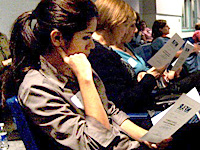
Teachers, aides, parents and professionals of students ages 14 and over are invited to join us for an informative evening that focuses on a variety of techniques used to teach adolescents social and communication skills needed for workplace and social environments.
The workshop will conclude with a panel comprised of several young adults with autism sharing their personal transition experiences and the important lessons they've learned.
Thursday, November 4, 2010
5:30 – 7:30PM
Pre-registration: $15
Registration night of event: $20
EVENT SCHEDULE
5:00 PM – Registration and light refreshments
5:30 PM – Introduction
The Importance of Transition Training
Bonnie R. Kraemer, Ph.D., BCBA-D
Associate Professor, Department of Special Education
San Diego State University
School-Based Social Skills Training for Adolescents with Autism Spectrum Disorder: The PEERS Program
Shayla Green, M.A.
Special Ed. Teacher, El Cajon Valley High School
Use of Written Scripts to Increase Social Communication Skills in Adolescents with Autism
Pamela Johnson, M.A.
Special Ed. Teacher, Steel Canyon High Schoo
Developing Oral and Written Workplace Communication Skills
Marilea Brock, M.S., CCC-SLP
Deanna Hughes, Ph.D., CCC-SLP
Crimson Speech Language Treatment and Research Center
Panel Discussion
Lessons learned by young adults with autism
Questions & Answers Session
- iPhone and iPod Touch Apps for Special Education — Download PDF (1.8mb)
- More Apps for Education — Download PDF (152k)
- Jessica Collins NFAR Presentation — Download PPT (1.8mb)
- iPod Touch and iPad as Assistive Technology — Download PDF (72k)
- Apps for ASD iPod Touch Project — Download PDF (4.5mb)
Using Technology in the Classroom
- 18 August 2011
- Workshops
-
Last October, special education teacher Jesseca Collins (Village Elementary in the Coronado Unified School District) was awarded a NFAR Autism Teachers Grant for the use of an iPad. Over the course of the year, we at NFAR hoped to gain a better understanding of the iPad as a classroom tool.
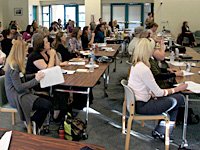
One of three presenters at our recent Spring Education Workshop, Jesseca was excited to report on her experience using iPad technology. She provided specific examples of the software and applications she currently uses with her students and shared the following:
Pros
- The iPad can be a huge motivator for students on the spectrum.
- There are many great programs available for the iPad that are affordable and designed to further enhance academic and social skills, speech and language skills, and fine motor skills.
- The programs are engaging and fun for the kids and it adds variation to classroom programming, while saving you time creating materials by hand.
- Some apps will record a student’s progress and additional data that can be very useful in tracking goals.
- Even the most challenging students began to work longer and with improved attention to task when using iPad technology.
- Most students are able to use the iPad on their own, showing increased levels of independence.
- By focusing on using the iPad to supplement one goal per student at a time, Jesseca and her team were able to successfully track and record progress without getting overwhelmed.
- The device is durable and requires little training to learn how to use.
Cons
- The iPad typically can only be used by one student at a time.
- The students are not interacting with people when they use the device independently. It is important to also provide support and engagement with students while using the device.
- The iPad serves mainly as a supplement to other programs and teaching methods and is not a full replacement.
- Educators will have to work with their IT department on how to best manage back-up and storage, software licenses and purchase of applications.
Overall, Jesseca found the iPad, and its applications, could make an immediate and meaningful impact in a classroom. Requiring only a small investment of time to learn the device and to research relevant applications, the iPad can make an invaluable impact in the education of students with autism.
Additional resources from Jesseca’s Spring Educational Workshop.